Friday Night Lights Used to Mean Something Completely Different: The Reinvention of the American High School Athlete
Friday Night Lights Used to Mean Something Completely Different: The Reinvention of the American High School Athlete
In the fall of 1975, a 16-year-old running back in Ohio pulled on a helmet that had been worn by at least three players before him, ran drills on a grass field that was mostly dirt by October, and went home after practice to eat dinner with his family. He played basketball in the winter. He ran track in the spring. In the summer, he mowed lawns and hung out with his friends.
He was a high school athlete. A good one, maybe. But the identity didn't consume him.
Fifty years later, a 16-year-old running back in a similar town might be wearing GPS-enabled training gear, working with a private speed coach, attending a summer showcase camp where college recruiters evaluate him on film, managing a highlight reel on social media, and specializing exclusively in football — year-round, since age 10.
Same sport. Same age. Almost entirely different experience.
The Old Version: Seasonal, Simple, Local
High school sports in mid-20th century America operated on a rhythm that seems almost quaint now. Athletes played multiple sports — not because anyone told them to, but because that's what you did. Football in the fall, basketball in the winter, baseball or track in the spring. The sports were seasonal, and the seasons ended.
Coaches were usually teachers at the school. Training was basic by modern standards: conditioning drills, fundamental skill work, film review if the school had the equipment. Nobody talked about heart rate zones or functional movement screening. If you were sore, you played through it. If you were really hurt, you sat out until you weren't.
Equipment was functional at best. Many schools passed helmets and pads down through classes, replacing gear only when it was genuinely unusable. Practice fields were maintained with whatever the school budget allowed, which often wasn't much. Weight rooms, where they existed at all, were modest — a few barbells and a Universal machine in a converted storage room.
Recruitment by college programs happened, but it was slower and less systematic. Scouts came to games. Coaches made phone calls. The process didn't begin when a player was in middle school. There were no rankings databases tracking 14-year-olds.
And critically: there was no industry built around it.
The Machine That Grew Up Around Youth Sports
Somewhere in the 1990s and 2000s, American youth sports stopped being a neighborhood activity and started becoming a business.
The travel sports industry — club teams, showcase tournaments, recruiting camps, private coaching — grew into a multi-billion dollar sector. Families began spending thousands of dollars per year, sometimes per month, on their child's athletic development. The logic was understandable: competition intensified, college scholarships seemed within reach, and the system rewarded early specialization and visibility.
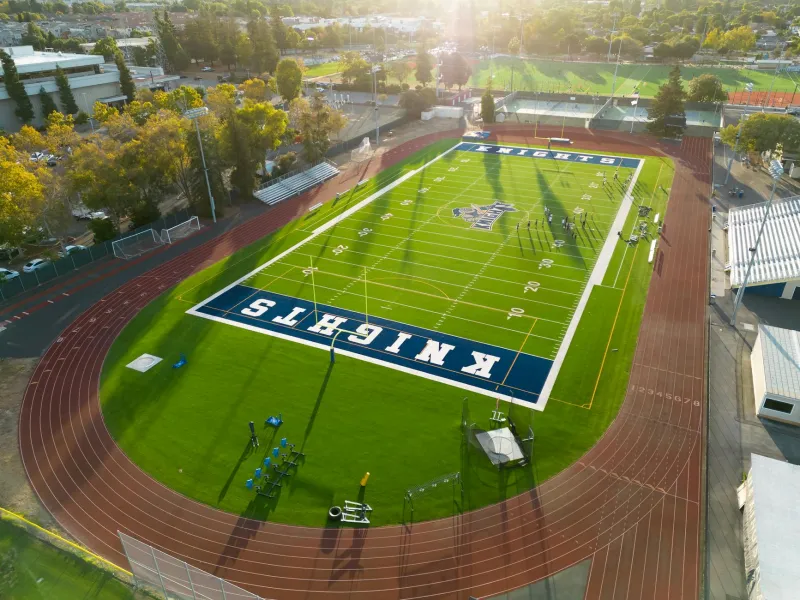
By the 2010s, the infrastructure around high school athletics had been almost completely rebuilt. Elite programs at well-funded schools now feature facilities that would have been unimaginable in 1975 — climate-controlled weight rooms, turf practice fields, video analysis systems, dedicated athletic trainers, and nutrition counseling. The gap between well-resourced and under-resourced programs widened dramatically.
For athletes in those top-tier environments, the experience is closer to a minor league development system than a school extracurricular. Strength and conditioning coaches design individualized training programs. Sports psychologists work with teams on mental performance. Recruiting coordinators help athletes navigate the college process from sophomore year onward.
The Data Revolution Hits the Prep Level
Technology that was exclusive to professional sports a decade ago has trickled down to the high school level in ways that would seem like science fiction to a coach from 1975.
GPS vests that track distance covered, sprint speed, and workload during practice are now used at some high schools. Wearable heart rate monitors help coaches manage training load and recovery. Video platforms allow coaches to break down film with the kind of detail that NFL coordinators once monopolized.
For individual athletes, apps track nutrition, sleep, and recovery. Social media has created a parallel recruiting economy where a well-produced highlight reel can reach college coaches directly, bypassing traditional gatekeepers. Platforms dedicated to recruiting rankings and prospect evaluations have made the process more transparent — and more anxiety-producing — than it has ever been.
A teenager who wants to be seen by college programs today doesn't wait to be discovered. They market themselves.
What the Professionalization Cost
The gains are real. Modern training science has made young athletes faster, stronger, and better prepared than their predecessors. Injury prevention has improved. The understanding of concussion risk, overuse injuries, and long-term athlete health has advanced significantly since the era when coaches told players to "shake it off."
But the costs are real too, and they're worth naming.
Early specialization — committing to a single sport before adolescence — has been linked to higher rates of overuse injuries and burnout. The American Academy of Pediatrics has repeatedly cautioned against it. Yet the economic logic of the travel sports system pushes families in exactly that direction. If your child isn't specializing at 12, the fear goes, they'll fall behind the kids who are.
The financial barrier has also reshaped who participates at the highest levels. Club sports and private coaching are expensive. Families without disposable income are increasingly locked out of the development pathways that lead to college exposure. The neighborhood kid who showed up and made the team because he was naturally talented — a story central to American sports mythology — is a harder story to tell when the system requires years of paid investment before high school even begins.
And the psychological weight on young athletes is genuinely different than it was in 1975. Social media exposure, recruiting pressure, and the sense that every practice and every game has long-term consequences have created levels of performance anxiety that previous generations of high school athletes simply didn't carry.
The Same Name, a Different Game
The 16-year-old in Ohio in 1975 and the 16-year-old in Ohio today are both called high school athletes. They compete under the same rules, wear the same numbers, play on the same fields.
But the systems surrounding them — the expectations, the economics, the technology, the pressure, and the identity that comes with the label — have been rebuilt almost entirely from the ground up.
Whether that's progress depends on what you think youth sports are supposed to be for. If the goal is producing elite athletes, the modern system is measurably more effective. If the goal is giving kids a healthy, formative experience of competition and teamwork, the answer is a lot less clear.
Friday night still lights up across America every fall. But the world that surrounds those lights looks almost nothing like it did fifty years ago.