The Guy Who Fixed Everything on Maple Street: What Happened to America's Repair Economy
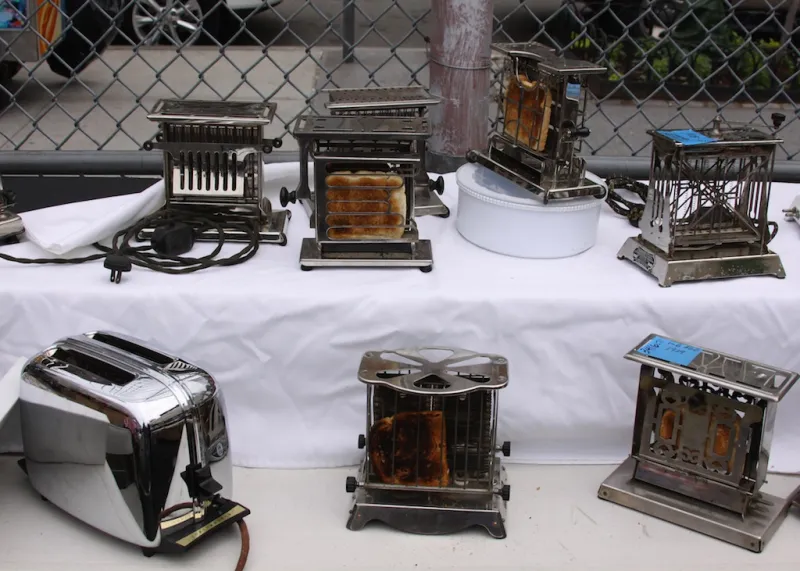
Photo: vintage appliance repair shop technician fixing toaster 1970s, via i0.wp.com
Somewhere in the back of a closet in millions of American homes, there's a drawer — maybe it's actually a box, maybe it's a shelf in the garage — full of broken things nobody has gotten around to dealing with. A lamp with a frayed cord. A toaster that stopped popping. A blender with a cracked housing. A vacuum that makes a sound it definitely shouldn't.
These items are in limbo. Not quite trash, not quite functional. Waiting for a decision that, statistically speaking, will almost certainly end with a trip to the big-box store and a replacement purchase.
Fifty years ago, those same items would have gone to a repairman. Not eventually. Pretty quickly, actually, because people expected broken things to be fixed, and there was an entire economy built around doing exactly that.
The Repair Shop Was a Neighborhood Institution
From roughly the 1940s through the early 1980s, the small appliance repair shop was as common a feature of American commercial life as the barbershop or the hardware store. Most towns of any real size had at least one — sometimes several, often specializing by category. Radio and TV shops. Shoe repair cobblers. Watch repair. Small appliance service centers authorized by manufacturers to work on their products.
These weren't marginal operations. They were legitimate small businesses with trained technicians, genuine expertise, and steady customer bases. A broken Sunbeam mixer or a malfunctioning Zenith television set represented real money, and people expected those things to be repaired rather than replaced. The economics made sense: repair cost less than replacement, and the products were built with enough quality and longevity that they were worth fixing.
The repairman — and it was almost always a man, in that era — often knew his customers by name. He knew which families brought in the same brand of vacuum every few years, which households had a teenager who was hard on equipment. It was a relationship business, embedded in the community in the same quiet way the local pharmacist was.
How Products Started Becoming Disposable
The shift didn't happen overnight, but the trajectory is pretty clear in retrospect. Through the 1970s and especially the 1980s, manufacturing began moving offshore in earnest. Labor costs dropped. Products got cheaper to produce, which meant they got cheaper to buy — but also cheaper in quality. The price gap between "buy new" and "pay for repair" began to close.
By the 1990s, the calculus had flipped for a lot of product categories. Why pay $60 to have a toaster repaired when a new one costs $35? The rational consumer choice was obvious, and millions of Americans made it simultaneously. Repair shops began losing business not because people stopped valuing the service, but because the service stopped making financial sense relative to replacement.
Manufacturers noticed. And some of them, if we're being honest about it, were perfectly happy with the outcome. A customer who repairs a product is a customer who doesn't buy a new one. A customer who throws it out and replaces it every three to five years is a customer who keeps the revenue stream flowing. The business model of planned obsolescence — designing products with a limited functional lifespan — became increasingly standard practice across consumer electronics and appliances.
The Right to Repair Problem
Here's where it gets particularly interesting. By the time consumers started to push back — by the 2010s, a genuine "right to repair" movement had emerged — manufacturers had erected new barriers to keep independent repair out of the picture entirely.
Apple famously designed screws that required proprietary tools to remove. John Deere wrote software licensing agreements that prevented farmers from repairing their own tractors. Electronics manufacturers stopped making parts available to independent shops. Repair manuals disappeared behind corporate walls. The official message was often about safety or quality control, but the practical effect was the same: repair became harder, more expensive, and in some cases literally impossible without going back to the manufacturer.
The right to repair movement scored some real wins — several states passed legislation requiring manufacturers to make parts and tools available, and the FTC began taking a harder look at repair restrictions. But the underlying culture of the industry hadn't fundamentally changed. Disposability remained the default assumption built into most product design.
What the Job Market Lost
The collapse of the repair economy wasn't just a consumer story. It was a jobs story too, and not a flattering one.
Appliance repair, electronics service, and related skilled trades employed hundreds of thousands of Americans through the postwar decades. These were good jobs — not glamorous, but skilled, stable, and reasonably well-compensated. They required real expertise and rewarded people who were good with their hands and sharp at diagnostics. They were also, critically, local jobs. The money a customer paid to fix their washing machine stayed in the community.
As repair shops closed — the Bureau of Labor Statistics has tracked steady, significant decline in appliance repair employment since the 1990s — those jobs didn't get replaced by equivalent work. They got replaced by retail sales positions at stores selling the replacement products, and by warehouse and logistics jobs supporting the supply chains delivering them. The skill premium largely vanished.
The Environmental Arithmetic Nobody Likes to Do
There's a layer to this story that doesn't get discussed enough: the sheer volume of material being discarded. The EPA estimates Americans generate around 50 million metric tons of electronic waste per year. That's circuit boards, plastics, metals, and toxic components going into landfills or being shipped overseas for informal and often hazardous processing.
A culture that fixed things generated a fraction of that waste. When a toaster lasted twenty years because someone repaired it twice, it occupied landfill space once. When a toaster gets replaced every four years, it occupies landfill space five times over the same period. The environmental math is straightforward, even if our consumer habits don't reflect it.
The Fix-It Renaissance, Small but Real
There are signs of a genuine counter-movement, though it's modest against the scale of the problem. "Repair cafes" — community events where volunteers help people fix broken items — have spread across the country. YouTube has turned millions of people into competent DIY repairers who would never have attempted it otherwise. iFixit, the online repair guide platform, has built a substantial audience of people who'd genuinely rather fix than replace.
But these are currents running against a powerful tide. The repair economy that existed in 1965 was built on a foundation of products designed to last, parts that were available, and skilled tradespeople who made a living fixing things. Rebuilding that foundation would require changes in manufacturing philosophy, regulatory policy, and consumer expectation that won't happen quickly.
The guy on Maple Street who fixed everything isn't coming back anytime soon. But the fact that people are looking for him again might be the most interesting development in American consumer culture in years.