Splinters, Scraped Knees, and the Best Childhood Anyone Ever Had: What Happened When America Bubble-Wrapped the Playground
Ask anyone who grew up before 1990 to describe their elementary school playground and you'll get a story that sounds like an OSHA violation. Tall metal slides that baked in the summer sun until they could brand your thighs. Merry-go-rounds that spun fast enough to generate legitimate centrifugal force. Monkey bars over packed dirt, positioned at a height that made falling a real negotiation between gravity and your grip strength.
Kids got hurt. Sometimes seriously. And then they came back the next day and got on the merry-go-round again.
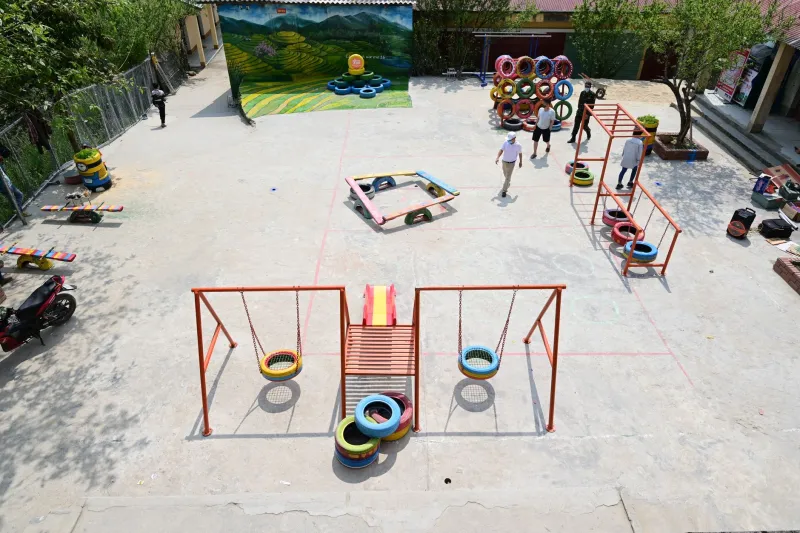
The playground that exists today — rubberized surfaces, rounded edges, equipment heights capped by federal guidelines, sight lines engineered for adult supervision — is undeniably safer. It is also, by almost any honest assessment, a less interesting place to be a kid. The question worth asking is whether safety was the only thing that changed.
How the Old Playground Actually Worked
The mid-century American schoolyard wasn't designed by child development experts or liability consultants. It was often built by the community — parents, teachers, and local tradespeople who put up what they could afford with what they had. Wooden structures, metal hardware, and a general philosophy that children were more durable than they looked.
Supervision was minimal by modern standards. A teacher might do a sweep of the yard, but the operating assumption was that kids would sort themselves out. And they largely did — through negotiation, hierarchy, improvised rules, and the occasional fistfight that ended in a handshake. The playground was one of the few environments in a child's life where adult authority receded far enough that genuine peer society could form.
That society had its own economy, its own justice system, and its own culture. You learned who was fast and who was fair. You learned how to talk your way into a game and how to absorb a loss without crying about it. You learned, sometimes painfully, that the world didn't reorganize itself around your comfort.
The Liability Revolution
The transformation didn't happen overnight, but it accelerated sharply in the 1970s and 1980s as personal injury litigation became a more common feature of American life. School districts and municipalities faced lawsuits over playground injuries, and insurance companies began attaching conditions to coverage that effectively mandated safer equipment and surfaces.
The Consumer Product Safety Commission started publishing playground safety guidelines in 1981. By the 1990s, those guidelines had hardened into something closer to de facto standards, and the old equipment began disappearing — pulled down, not always replaced, and when replaced, replaced with something engineered to minimize the chance that any child would ever experience a consequence severe enough to generate paperwork.
 Photo: Consumer Product Safety Commission, via www.marefa.org
The rubberized surface beneath modern equipment is perhaps the most visible symbol of the shift. It is genuinely effective at reducing head injuries from falls. It is also soft in a way that removes one of the oldest and most reliable childhood lessons: the ground is hard, so don't fall.
What the Research Actually Shows
Here's where the story gets complicated, because the data on childhood injury rates isn't as clean as the liability revolution's advocates might suggest. Serious playground injuries — the kind requiring emergency room visits — did decline significantly as equipment was redesigned and surfaces improved. That's real, and it matters.
But researchers studying child development began raising a different set of concerns. Ellen Sandseter, a Norwegian psychologist whose work gained significant attention in the US, argued that children have an innate drive toward risky play — climbing high, moving fast, navigating uncertain terrain — and that this drive serves a developmental function. It's how kids learn to calibrate risk, manage fear, and build the kind of physical confidence that doesn't come from a rubberized mat.
 Photo: Ellen Sandseter, via images.pod.co
Other researchers noted that as playgrounds became safer, children began spending less time on them — not more. The equipment that remained was frequently described by kids as boring. Adventure playgrounds, a European concept that involves loose materials, tools, and genuine creative freedom, consistently showed higher engagement and more complex social play than their sanitized American counterparts.
The Generation That Grew Up on Gravel
There's a reason people who grew up on the old playgrounds talk about them with a specific kind of nostalgia that goes beyond mere sentiment. The physical environment shaped the social environment. When the equipment was genuinely challenging, getting to the top of the jungle gym meant something. It was an achievement that the other kids could see and evaluate. The playground had a natural meritocracy built into its topography.
It also had genuine stakes. When you knew that falling from the monkey bars meant landing on something that didn't forgive, you paid attention differently. You developed spatial awareness, physical judgment, and a relationship with your own body's limits that no amount of age-appropriate, surface-cushioned play equipment can fully replicate.
This isn't nostalgia dressed up as developmental theory. It's a genuine question about what environments produce what kinds of people — and whether the elimination of physical risk in childhood has contributed to the broader documented rise in anxiety, risk-aversion, and difficulty tolerating discomfort among younger generations. Researchers haven't reached consensus, but the conversation is happening in ways it wasn't twenty years ago.
The Trade-Off Nobody Fully Priced In
America made a choice, largely through litigation and insurance markets rather than democratic deliberation, to prioritize the elimination of physical injury in childhood play spaces. It was a defensible choice. Broken arms are real, head injuries are serious, and no parent wants their kid seriously hurt on school property.
But the playground was never just about physical activity. It was one of the primary arenas where American kids learned to be people — messy, competitive, creative, sometimes cruel, ultimately resilient people. When the equipment got safer, something in that process changed too.
The splinters are gone. The scraped knees are rarer. And somewhere in the gap between the old gravel pit and the new rubberized surface, a particular kind of childhood quietly ended.