When the Ball Diamond Was Two Blocks Away: How Youth Sports Left the Neighborhood Behind
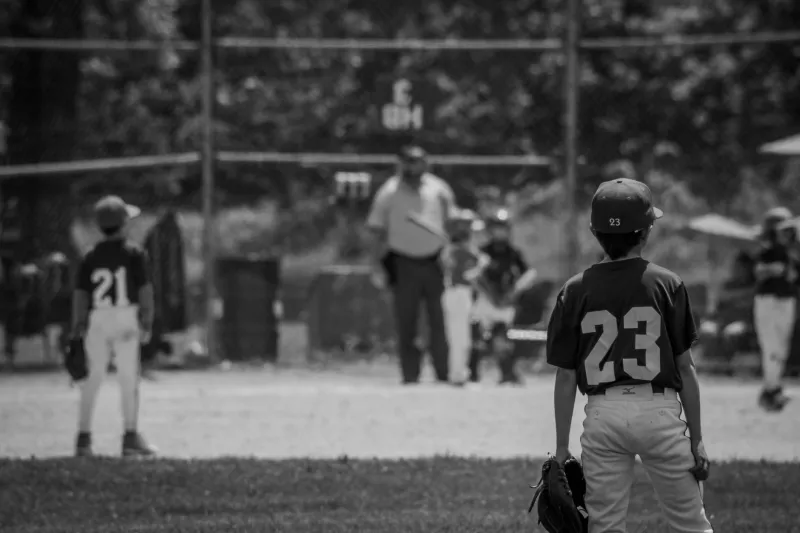
On any given Saturday morning in 1967, the Riverside Park baseball diamond in practically any mid-sized American city was packed. Kids in mismatched uniforms, hand-me-down gloves, and cleats that didn't quite fit were playing kids from three neighborhoods over. The coaches were dads who'd never taken a coaching clinic. The umpires were sometimes teenagers. The concession stand sold ten-cent hot dogs and flat Coke. Nobody's parents had driven more than eight minutes to get there.
 Photo: Riverside Park, via images.squarespace-cdn.com
The whole operation was run by the city parks department, funded by a $5 registration fee, and organized around one simple premise: kids in this neighborhood play kids in that neighborhood, and everyone goes home for lunch.
It worked beautifully. And it's almost entirely gone.
The Old Architecture of Kids' Sports
The postwar recreational sports system was a quiet civic masterpiece that most Americans have already half-forgotten. Cities and towns across the country built their youth athletics around a tiered, locally contained structure. The parks department ran the baseball and softball leagues. The YMCA handled basketball. Churches and civic clubs like the Elks or the Knights of Columbus organized football and wrestling. Costs were kept deliberately low — often subsidized by municipal budgets — because the whole point was broad participation, not elite development.
Geography was the organizing principle. You played in your district. Your opponents came from the next district. Travel was measured in minutes, not hours. A kid in Cincinnati played other kids from Cincinnati. A kid in suburban Cleveland played other kids from the same ring of suburbs. The rivalries were genuine and deeply local — your team played the same opponents year after year, and those games meant something in the way that only neighborhood competitions can.
Equipment was modest. Uniforms were often just matching T-shirts. Trophies, if they existed at all, were small. The season ended, everyone went home, and kids waited for next year. There were no showcases. There were no recruiting profiles. There was no footage.
And yet by most measures, the system produced excellent athletes, healthy kids, and communities that genuinely felt connected through shared competition.
How Travel Teams Changed the Equation
The travel team model didn't emerge from nowhere — it grew out of a genuine desire to give talented young athletes better competition and more development opportunities. In that narrow sense, the goal was reasonable. But the execution gradually consumed the entire landscape of youth sports, not just the elite tier it was originally designed for.
By the 1990s, travel teams were becoming a significant presence in baseball, basketball, and soccer. By the 2000s, they were dominant. By the 2010s, they had effectively replaced recreational leagues as the primary organized sports option in many American communities — particularly for kids between the ages of 10 and 14.
The financial commitment required is staggering by any historical comparison. A single season on a competitive travel baseball team can easily cost a family $3,000 to $5,000 when you add up registration fees, tournament entry fees, hotel stays, gas, equipment, and the specialized coaching that travel programs often charge extra for. Elite programs in major metro areas routinely run $8,000 to $10,000 per year. Per child. Per sport.
And the travel is literal. Families drive three, four, five hours each way to weekend tournaments. Hotels fill up with youth sports families every weekend from March through October. Youth baseball tournaments in places like Cooperstown, Myrtle Beach, and Gatlinburg draw teams from across the country — kids who are eleven years old, playing organized games in front of nobody except their own parents, in cities they've never visited before and won't remember visiting again.
What the Parks Department Lost
Here's the quiet casualty that rarely gets discussed: as travel teams absorbed the kids whose families could afford them, the old recreational leagues lost their best players, their strongest families, and eventually their political support. When middle-class and upper-middle-class families opt out of the parks department league, the parks department loses the constituency that advocates for its budget. Funding gets cut. Fields deteriorate. Programming shrinks.
What's left is often a recreational league that serves kids whose families can't afford travel teams — which is a meaningful and necessary service — but it no longer functions as the broad, community-wide institution it once was. The self-sorting is nearly complete. Youth sports in America now has a two-tier system: travel programs for families with means, and underfunded recreational leagues for everyone else.
The kids who fall out of both categories — too expensive for travel, too disengaged from a depleted rec league — often just stop playing organized sports entirely. The numbers bear this out. Youth sports participation rates have declined significantly over the past two decades, even as spending on youth sports has increased. More money is being spent on fewer kids.
The Neighborhood Game Nobody's Playing
There's a subtler loss beyond the economics, and it's harder to quantify. When kids played in neighborhood leagues, they developed relationships with opponents who lived nearby. The kid who struck you out in April might sit next to you on the school bus in September. The competition was embedded in a community context that gave it texture and meaning.
Travel team sports, by contrast, are often socially anonymous. You drive to a tournament, play three or four teams you've never seen before and won't see again, and drive home. The games are competitive, but they're contextless. There's no shared geography, no accumulated history, no sense that this rivalry means something beyond the weekend scoreboard.
There's also the question of what kids learn from a system built around constant travel, high stakes, and significant family investment. The old neighborhood leagues taught kids to compete against familiar faces, to lose gracefully to someone they'd see at school on Monday, and to understand sports as a normal part of community life rather than a specialized pursuit that required extraordinary sacrifice.
Getting Back to the Block
A handful of cities have started experimenting with low-cost, locally contained youth sports models — deliberately modeled on the old parks department structure. The results, where they've been tried, have been encouraging. Participation goes up. Dropout rates go down. Families report less stress.
But these programs swim against a powerful current. The travel team industry is now a multi-billion dollar business with strong incentives to keep growing. Coaching academies, tournament operators, equipment brands, and hotel chains all profit from the model as it currently exists.
Ray's kid used to grab his glove and walk to the park on Saturday morning. Now someone's kid is loading into a minivan at 5 AM for a six-hour drive to a tournament in Tennessee. Both scenarios involve youth baseball. Almost nothing else about them is the same.